|
Italian Wine Merchant, NYC
The retailer that started me on the road
to Italian wine. |
Vino Nobile di Montepulciano
When I first started my journey into Italian wine, it was a mixture of reading and knowledgeable sales people who helped me make my buying decisions. I still look back on those days with fondness, as I was trying so hard to taste everything and to understand all the differences from region to region and within all the Italian wine laws and regulations. It was dizzying, but magically so, in that each day held a new surprise and potentially a new wine that would peak my interests enough to dig deeper. Some wines stood out immediately and became the Italian foundation of my wine cellar, while others were nothing more than interesting enough to make note of or dedicate a brief time to study. For the most part, I succeeded, but I will admit that I made some hasty decisions.

Vino Nobile di Montepulciano was one of those hasty decisions. With all the amazing wines of Tuscany to explore, and so many other wines to taste, I somehow allowed one poor bottle of Vino Nobile to sway my opinion of this entire appellation in the wrong direction. For years I would reach for Brunello, Super Tuscans, Chianti, Carmignano, Chianti Ruffina or Bolgheiri before even considering Vino Nobile--and somehow, I managed to go the next four years without tasting a single bottle. I full-heartedly admit that it was a mistake.
This last February, while attending "The Italian Wine Masters" tasting in NYC, my eyes were opened to what Vino Nobile could be. A large part of this was from tasting back vintages of 1999 and 2001. These wines were majestic, pure, elegant, spicy, earthy and exactly what I wanted from a wine that is primarily Sangiovese at the age of ten or more years. However, another producer also stuck out to me, both because of the quality in the glass and the passion of the owner: Crociani
 |
| Susanna Crociani |
Susanna Crociani carries on a tradition of winemaking that has lasted for generations in Montepulciano. Crociani produces a full range of wines made from the traditional Tuscan grapes Prugnolo Gentile (Sangiovese), Canaiolo nero and Mammolo at their estate vineyards at Le Caggiole. The Crociani name was not one that I had heard of before recently, as their distribution in the states has been limited. However, I full truly hope that this will change soon. The wines are fantastic and amazing values for what you find in the glass. Being a fan of Sangiovese in all its forms, tasting the Vino Nobile of Crociani was a breath of fresh air. The wines show such remarkable freshness in their youth, yet have the stuffing to age gracefully and, with aeration, take on a remarkable amount of depth and nuance.
 |
Prugnolo Gentile
(Sangiovese) |
The entry-level Rosso di Montepulciano is a great any-day wine that lends well to food pairings with its zesty acidity and Tuscan terroir showing through. However, the Rosso d’Arnaldo took things to a whole new level as it wowed the palate with a sheen of rich decadence, yet still retained the fresh and vibrant qualities of the Rosso. As I moved into the Vino Nobile, the wine showed more elegance and an attractive spicy nature, but it was the Riservas that truly stole the show. Being able to taste a number of vintages from ’99, ’04, ’06 and ’07, I was truly able to see the progression of this bottling. In their youth, they are tight and in need of decanting, but with a core of dark red fruits. With a few more years in the bottle, they turn rich and showy as the core of fruit expands on the palate and takes on hints of earth and woodsy notes.

In experimenting with these bottles, I found myself buying more Vino Nobile to try and understand this region better. What I learned is that I adore them. These are great wines that are easily able to stand tall next to whatever Tuscany has to offer, and they will find a place in my cellar.
So the next time your tastes turn to Tuscany, look for a Vino Nobile di Montepulciano; it’s not just a pretty name or a gimmick. And if you can find Crociani, I think you’ll agree that they are well worth the price of entry, but give that Riserva a little time to blossom.
On to the notes…
2008 Crociani Rosso di Montepulciano Rosso d'Arnaldo – On the nose, an initial whiff of fresh herbs turned fruity and rich with cherries dipped in dark chocolate, cinnamon and notes of herbal tea. On the palate, it was mid-weight and silky as flavors of wild berry, mulling spices, dark wood and salinity spread across the senses. It turned slightly bitter, yet left a remarkably fresh impression on the finish. This was a joy to drink, and it’s an excellent and unique Tuscan alternative to Chianti.
(90 points)
2009 Crociani Rosso di Montepulciano – The nose showed brambly fruit with violet and hints of pepper. On the palate, I found a good balance of red fruit and acidity with woodsy tones, but the finish was a bit drying. This wine truly shines with a good meal.
(88 points)
1
999 Crociani Vino Nobile di Montepulciano – The nose showed dried red fruits with undergrowth, hints of green stems and pepper. On the palate, the fruits turned round and sweet, as this wine strutted a fine, mature structure with flavors of lush wild berries and spice. The finish was fresh and juicy.
(90 points)
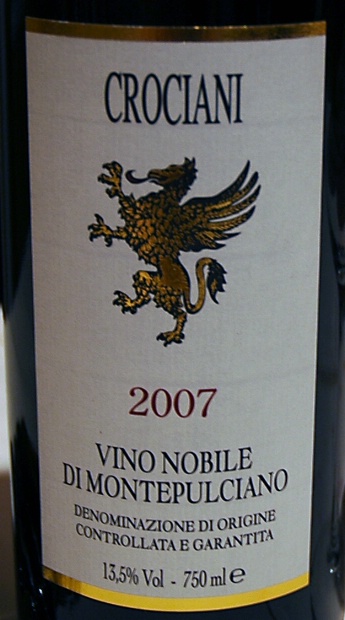
2007 Crociani Vino Nobile di Montepulciano – The nose showed masses of raspberry, cedar, herbs and a bit of older wood. The palate was structured, but not austere, and savory with rich black cherry. The finish coated the palate with fine tannin. This wine would benefit from a few years in the cellar.
(91 points)
2008 Crociani Vino Nobile di Montepulciano – It took two hours in decanter before this wine truly began to shine, but it was well worth the wait. On the nose, I found floral notes, sweet spices, dried apple and strawberry. On the palate, it was soft and slightly spicy with plum and a hint of salinity. The finish rounded out nicely with decanting and showed notes of soil and herbal fruit tea.
(90 points)
2004 Crociani Vino Nobile di Montepulciano Riserva – The nose showed crushed wild berries, woodland notes and soil. With time in the glass, the bouquet turned darker and richer, as whiffs of sweetened herbal tea and cinnamon stick came to the fore. On the palate, it was elegant with rich red fruits, orange rind, rose petal and notes of beefy broth. The rich red fruit turned to juicy cherry as the wine came together on the finish. This bottle was beautiful and is drinking well now with proper decanting.
(93 points)
2006 Crociani Vino Nobile di Montepulciano Riserva – The nose showed red fruits, violets and a hint of toast. On the palate, I found a rich, full-bodied wine, with brambly red fruit and cedar. The finish was smooth and long.
(91 points) Find it: Wine-Searcher!
2007 Crociani Vino Nobile di Montepulciano Riserva – The nose showed crushed sour berries, sweet spices and lavender with hints of wood barrel. On the palate, a core of dark red fruit is wrapped in silky tannin with minerals, notes of herbal tea and hints of sweetness on the mid-palate. Red berries linger on the medium long finish.
(92 points)
2003 Crociani Vin Santo di Montepulciano – The nose showed intense almond, cotton candy and coffee notes. On the palate, this wine was refined, showing roasted nuts, orange peel and toffee but with less sweetness than I’ve come to expect from Vin Santo. Ultimately, this was a pleasure to drink as it showed remarkable balance and refinement.
(92 points)
Visit the
Crociani Website.
Find the wines of Crociani on
Wine-Searcher!


 That tasting was the catalyst for my exploration into the wines of Felsina. I soon came to realize that this producer of Chianti Classico, Vin Santo, cabernet sauvignon and olive oil was a step above the rest in almost every aspect, and the wines continue to provide an excellent quality-to-price ratio, with their entry level Chianti Classico Riserva at $25.
 When you consider that these are two of the top shelf wines, it paints a pretty good picture of what Felsina is capable of. In the 2008 vintage, where much of Tuscany turned out easy-drinking, yet enjoyable, Chianti Classico, Felsina continued to deliver the goods and produced an excellent set of wines that will stand the test of time.

 2008 Fattoria di Felsina Chianti Classico Rancia Riserva – The ’08 Rancia was unexpectedly open at this young age. The nose showed red berries, cocoa powder and deep floral notes. On the palate, it was open and juicy with red berry fruits. The finish showed more of the structure I was expecting. This is a fine example of Rancia that, in this year’s case, is more open in its youth than the Fontalloro. (93 points) Find it on Wine-Searcher!
 Felsina’s Maestro Raro is a mono-varietal Cabernat Sauvignon from a vineyard adjacent to Rancia. It’s a beautiful Cabernet with true Tuscan character. It’s not the easiest wine to find, but it's certainly worth the search.