Showing posts with label Chianti Classico. Show all posts

Friday, January 24, 2020

No Fiasco In Sight: With Marco Ricasoli

The next addition to my video interview series is now live on YouTube. Join me as I sit with Marco Ricasoli to discuss his family's long history in Tuscany and Chianti Classico. This family can lay claim to being a major player in the region since the 7th century, as well as being a part of creating the original recipe for Chianti Classico in the late 1800's. However, it's what Marco is doing today at the Rocca di Montegrossi estate, that has me excited. Enjoy!


Also, make sure to check out our vertical tasting of his highly acclaimed Chianti Classico Gran Selezione, The San Marcellino, at The Cellar Table Blog


Monday, April 14, 2014

A Chianti Lovers Dream: The 2010 Riservas

The '95 Felsina Chianti Classico
Riserva is still going strong at age 19
An article by: Eric Guido

Some wine is meant for the cellar, while most can go right to the table. But these generalizations tend to fade when talking about Chianti Classico. In their youth, these are fun and fruity wines with enough acidity and structure to carry a meal. However, as they mature they soften, grow darker, and begin to display more earth, natural wood and spice. It is this evolution that keeps me putting bottles of Chianti Classico in the cellar.  In a good vintage, it is one of the most versatile wines being made today.  However, where a regular Chianti Classico (normale) will bring you night after night of enjoyment at your dinner table, the Riserva level wines mature beautifully in the cellar.  Which brings us to the 2010 Chianti Classico Riservas.


Classic is a word often used to describe the long, cool growing season in 2010, with a decent amount of rain moderated by periods of extended warmth and sunshine. This mix produced exciting wines of structure with juicy acidity and bright, focused fruit that really grabs your attention and holds it from the first glass through the last. Most of the straight Chianti Classico's are drinking beautifully right now, yet the 2010 vintage played right into winemakers' hands, allowing them to create Riserva level wines of exceptional quality and agebility. These are serious Chianti Classico that show the best qualities of the region and belong in your cellar. The early drinking 2011 vintage will give you more to drink over the next few years, but for me; stocking up on 2010 is my priority, because these wines should provide two decades (or more) of enjoyment.

Here's a list of some of the best 2010 Chianti Classico Riservas, in a number of price ranges, that I've tasted this year.

On To The Tasting Notes:

2010 San Giusto a Rentennano Chianti Classico Le Baroncole - The nose showed an intense burst of woodsy raspberry and cherry with hints of floral undergrowth, cedar and herbs, offset by a whiff of dark chocolate. On the palate, this showed silky textures with a vibrant, sexy personality, coating the senses with ripe red fruits and spice. Beneath it all was a refined structure that you could miss on a single sip under all that intense fruit. The finish turned fresh, yet grainy tannin could still be felt on the palate. This was a remarkably balanced wine with a slight inflection of oak, that's drinking great now, but should get even better with time. (94 points) Find it on: Wine-Searcher! (avg. $45)

2010 Fontodi Chianti Classico Riserva Vigna del Sorbo - The nose was restrained at first, yet became more giving with time in the decanter. Tart black cherry, moist fall leaves, dried flowers and licorice were all on display, yet still holding back. On the palate, it was tense, yet concentrated and dark with compact cherry, wood (not oak) and leather notes, kept in check by a stern tannic backbone. The finish was youthful and ungiving, needing years in the cellar to show it’s true colors, yet the potential is there. This is a wine for the cellar. (94 points) Find it on: Wine-Searcher! (avg. $75)

2010 Fattoria di Fèlsina Berardenga Chianti Classico Riserva - The nose was restrained and youthful, showing young cherry, dried flowers, animal musk, minerals, and Tuscan dust. On the palate, it showed silky textures with tart cherry and dried spices, which quickly firmed up with fine-grained tannin. Compact flavors of red fruit and cedar lingered long on the dry, tense finish. This 2010 riserva is in need of five to ten years in the cellar, and should be wonderfully classic as it matures. (92 points) Find it on: Wine-Searcher! (avg. $27)

2010 Castello di Monsanto Chianti Classico Riserva - The nose showed cherry with hints of stem, animal musk and a bright herbal note, which provided lift. On the palate, I found vibrant red fruits, spice, old wood tones and hints of soil. The finish showed hints of structure with juicy red fruits.  This is a great Chianti Classico Riserva in the value category; it's drinking great now with proper decanting, and can go a decade or more in the cellar. (91 points) Find it on: Wine-Searcher! (avg. $20)

2010 Antinori Chianti Classico Villa Antinori Riserva - The nose showed ripe black cherry, minty herbs, cedar and dark oak looming in the background. On the palate, it was rich yet remained fresh throughout. Spicy red fruit, leather and notes of dark chocolate cascaded along the palate, leaving concentrated red berry fruit on the finish. Although the oak was more pronounced than I usually prefer, I still found it enjoyable. This wasn't my cup of tea, but if oak with your Sangiovese is a quality you appreciate, this wine will be for you. (89 points) Find it on: Wine-Searcher! (avg. $32)

Monday, November 25, 2013

The Difference a Vintage Can Make

Two very different wines and two very different vintages,
both beautiful for different reasons.
Any reader of mine will know that I am a huge fan of Chianti Classico. Years of trail and error, let downs and happy surprises, have left me with some very firm opinions about Chianti and Sangiovese from Tuscany in general. For one thing, many of these wines can age, as we will see from 2010. Yet, there’s absolutely nothing wrong with young Chianti, when made in a more open style or from a more accessible vintage, like 2011.

This brings me to San Giusto a Rentennano Chianti Classico, which is traditionally styled Chianti made from Sangiovese (95%) and a small amount of Canaiolo (5%). I decided to do a little side-by-side comparison tonight of the 2010 and 2011 vintages. Two very different wines, both marked by the vintages from which they hail. However, there’s also a little something more. In 2011, portions of the grapes added to the wine were whole clusters (stems and all), a practice found often in Burgundy, but seldom in Tuscany. The difference is quite noticeable and worth tasting for exploratory purposes alone.

In the end, these are both beautiful wines, for very different reasons, and I look forward to following them throughout the years. I would hope my readers would give them a chance as well.

On To The Notes:

2010 San Giusto a Rentennano Chianti Classico – The nose was radiant and dark showing rich black cherry, hints of cedar, undergrowth and crushed fall leaves. On the palate, it was tight yet focused with tart red fruits, spice and herbs. Vibrant acidity kept the mouth watering, yet this wine needs a couple of years in the cellar to unwind. The finish showed a bitter twang with drying tannin coating the senses. This was enjoyable, but more for it’s, possible, future potential than it’s performance tonight. (90 points) Find it on: Wine-Searcher! (avg. cost $20)

2011 San Giusto a Rentennano Chianti Classico – The nose was bright and vibrant, showing tart cherry, stemmed strawberries, and autumnal spice with hints of pine. On the palate, it caressed the senses with soft red fruits accompanied by textbook Sangiovese acidity. This wine practically sizzled on the palate, with notes of cedar, herbs and spice. The finish was refined, showing hints of structure, yet fully enjoyable today. (91 points) Find it on: Wine-Searcher! (avg. cost $20)

The 2010 is tight and tart, a wine that I’d love to revisit in a few years. If the fruit unwinds and catches up with the absolutely beautiful bouquet, then this wine could one day be gorgeous. The 2011 is more open, yet still a stern, acid driven Sangiovese. Today, I’d reach for the 2011, without question. Yet, I have a feeling that the 2010 will improve for years to come.

Tuesday, September 3, 2013

"The" Italian Wine Grape: Sangiovese

Every year, as the summer begins to melt away and hints of cooler autumn days can be seen off in the distance, I find myself craving Sangiovese. I will admit, even with my intense love of the Nebbiolo grape, that Sangiovese holds a very special place in my heart and in my cellar. You could say that Sangiovese is “The” Italian wine grape, with a storied history going back to the 18th century and its earliest documented mention in 1590. It is also the most widely-planted red wine grape variety in all of Italy. Sangiovese is the star performer behind many of Italy's premier wines, including Chianti Classico, Vino Nobile di Montepulciano, Brunello di Montalcino, Morellino di Scansano and many of the Super Tuscan IGT bottlings.

Sangiovese is widely planted throughout the regions 
of Tuscany, Umbria, Emilia-Romagna, Abruzzo
and the Marche
Central Italy is the area most planted with Sangiovese, often coined the Sangiovese belt. Tuscany is obviously the most famous of these regions with a number of great expressions, but you will also find it widely used in Umbria, Emilia-Romagna, Abruzzo and the Marche. Of course, Sangiovese isn't limited to Italy either, with many wines being made from California, Romania and Argentina. However, I'm still not convinced by most of these wines and find that Italy has little competition.

Courtesy of Wine Folly
"Guide to Sangiovese"
Honestly, I believe it has much to do with experience and acceptance of the grapes’ inherent traits. Sangiovese is naturally light in color with high acidity, stern structure and flavors of tart red fruits, herbs, leather and tea leaves. When a balance is stuck between these components, the results are beautiful. However, when not allowed to ripen perfectly, the stern structure and brisk acidity seem to dry out the fruit, making the experience painful. In some parts of the world, this balance is missed by over-ripening or the excessive use of oak.

Due to its inherent traits, Sangiovese is often blended with a large number of other grape varieties, but it's important that the percentage isn't too high, as its qualities can be lost against the backdrop of too much Cabernet, Merlot and Syrah. With that said, there are many great Sangiovese-based wines that are perfectly blended with international varieties.

However, the Sangiovese purist would insist on a 100% Sangiovese or having it with more traditional Italian grapes, such as Canaiolo, Ciliegiolo, Mammolo and Colorino. It also responds well to moderate use of oak, but it loses much of its natural beauty when overdone.

In the end, Sangiovese is worth the search, and there's enough of it out there to keep you busy for a long time. Each expression has its own unique characteristics, making the exploration into this variety a never-ending journey for those wishing to delve in. In the next few months, expect more on Brunello di Montalcino, Vino Nobile di Montepulciano and a number of Super Tuscans.

Until that time, it is my opinion that Chianti Classico is probably the best place to start, and there’s nowhere better than the 2010 vintage. Classic is a word often used to describe the long, cool growing season in 2010, with a decent amount of rain moderated by periods of extended warmth and sunshine. This mix produced exciting wines of structure with juicy acidity and bright, focused fruit that really grabs your attention and holds it from the first glass through the last. Most of these wines are drinking beautifully right now, with a few that demand some time in the cellar. All of them perform much better at the dinner table, due to their brisk acidity. These are serious Chianti Classico that show the best qualities of the region and belong in your cellar. As for 2011, I’ll talk about them later in the year, for now; stocking up on 2010 is my priority.

On To The Tasting Notes:

2010 Fontodi Chianti Classico - The nose showed great intensity with red berry fruits, Tuscan dust, savory herbs, grilled meats and mineral tones. It came in waves with a dark and concentrated bouquet. On the palate, it was firm yet bursting at its tailored seams with tart cherry and something like a rich reduction of red meat and herbs. It was quite notable for its sweet, yet tart, yet savory personality. I found myself loving this wine more and more with every taste. The 2010 Fontodi Chianti Classico really hit its sweet spot after an hour open in bottle. (93 points) Find it on: Wine-Searcher!

2010 Isole e Olena Chianti Classico - The nose was vibrant and inviting with ripe cherry, autumnal spices, undergrowth, tobacco and crushed fall leaves. On the palate, it impressed with it's silky-smooth, medium body, and juicy red fruit, which seemed to touch on all the senses, followed by hints of spice and cedar. It was warming and finessed with a refreshing finish and balanced structure, which begged for another sip. Nowhere did I find the harsh tannin or elevated acidity that would usually accompany such a young Chianti, this was simply a pleasure to drink. (92+ points) Find it on Wine-Searcher!

2010 Castellare di Castellina Chianti Classico - The nose showed rich black cherry, ripe plum, exotic spice and herbs with hints of animal musk grounding it to it's Tuscan origins. It was highly expressive and brooding on the nose with a dark ruby color in the glass. On the palate, a vibrant core of acidity ushered in flavors of ripe red medicinal fruit and spice, yet soft and textured. It was a pleasure to drink and finished fresh with hints of structure giving balance to it's red fruit and floral tones. An excellent wine and an amazing value. (92 points) Find it on: Wine-Searcher!

2010 Fattoria Poggiopiano Chianti Classico - The nose was a beautiful mix of ripe black cherry fruit and fresh, sweet floral tones, as notes of graphite and cinnamon rounded out the bouquet. On the palate, it was mid-weight with brisk acidity taking center stage, backed by juicy cherry and mountain herbs. A slight bitter note resonated on the finish, but didn't detract as hints of juicy red fruit and cedar faded from the palate. This was a beautiful Chianti with stunning aromatics and a great "drink me" presence on the palate, a perfect food wine. (91 points) Find it on: Wine-Searcher!

2010 Querciabella Chianti Classico - The nose showed youthful cherry and spice with crushed fall leaves and a hint of cranberry. On the palate, it was rich yet balanced with refined structure and focused red fruits. The finish lingered on with notes of cranberry and fine tannin. This wine was just a baby and will likely be a stunner in another few years. (91 points) Find it on Wine-Searcher!

2010 San Felice Chianti Classico - The nose showed strawberry, cherry and herbs with hints of spice, animal musk and a touch of barnyard. On the palate, it showed ripe red berries and herbs with a juicy personality. The finish was full of saturating red fruits with hints of fine tannin, yet it left me with a pleasant, juicy impression. This is just what I want from an any-day Chianti. (89 points) Find it on Wine-Searcher!

2010 Rocca delle Macie Chianti Classico - The nose was fresh and floral with cherry, cedar, spice and hints of cinnamon and herbs. It coated the palate with rich raspberry and cherry fruits which slowly faded to reveal fine tannin and mouth-watering acidity. The 2010 Rocca delle Macie Chianti Classico is firm yet satisfying with excellent presence on the palate that screamed to be paired with a plate of pasta in red sauce. (89 points) Find it on Wine-Searcher!

2010 Antinori Chianti Classico Peppoli - The nose was flashy with a modern curve, showing medicinal cherry, deep wood tones, licorice and dark chocolate. On the palate, it was medium-weight with spicy, red berry fruits and a slightly creamy texture that quickly gave way to a bitter twang. The structure shined through on the finish with hints of drying tannin offset by sweet cherry and vanilla. The 2010 is an oak-accentuated, early-drinking and lighthearted effort meant more for a weeknight dinner than anything else, yet it still represents value in the $20 price range. (88 points) Find it on Wine-Searcher!

2010 Vignamaggio Gherardino Chianti Classico - The nose showed cool red berries with dark earth, herbs and Tuscan spice. On the palate, I found tart red fruits with a dry yet balanced presence on the senses. The finish was medium-long with tart red berries and hint of caramel. (88 points) Find it on Wine-Searcher!

* A big thanks to Wine Folly for their image of "The Color of Sangiovese", make sure to check out their site and "Guide to Sangiovese".

Wednesday, April 17, 2013

Fontodi: Modern Touch, Traditional Feel

By Eric Guido

With the start of each new year comes the myriad of Italian wine tastings that have become the highlight of these early winter months. Each year, I find myself tasting the new releases of all my favorite wines. This year, one winery that has truly stood out among the rest for its entire portfolio, it's the Tuscan property of Fontodi.

I have loved these wines in the past, often in their more mature states, yet two years ago I was left breathless by the youthful 2007 Fontodi Flaccianello della Pieve Colli della Toscana. From top to bottom, they are highly enjoyable wines that show tremendous relative value. However, this year, the entire range was something to be marveled at. The entry-level Chianti Classico is a wine that every lover of Italian wine should be enjoying today, while the Riserva level Vigna del Sorbo soared in its youthfulness, yet begged for time in the cellar; and the Flaccianello, while nothing like the 2007 is graceful, youthful and full of potential.

This organic estate is located in the heart of the Chianti Classico region, just south of the town of Panzano. Using a gravity-fed cellar and focused on maintaining the natural integrity of the grapes, Fontodi turns out beautiful Sangiovese-based wines with a modern touch. However, don’t write these off as modern wines, as the 2009 Flaccianello proves in spades. With less dependency on new oak, this wine shines like never before. If you haven’t experienced them before, now is the time, and if you have the chance to taste a mature Vigna del Sorbo, do not pass it up, as these are regal wines of the highest caliber.

2009 Fontodi Chianti Classico – The nose showed cherry sauce with Tuscan dust, spicy notes, hints of mushroom and citrus. On the palate, it was focused with refined red fruits and inner floral notes. The finish was clean with pure red fruits and hints of structure. This was easily one of the best entry-level Chianti I’ve tasted this year. (91 points) Find it on Wine-Searcher!

2009 Fontodi Chianti Classico Riserva Vigna del Sorbo – The nose showed red berries, floral notes, herbs and a slight hint of vanilla. On the palate, I found tart red berries with dusty spices and herbal notes leading to a structured finish with fine grain tannins. This was a great young expression of Vigna del Sorbo. (93 points) Find it on Wine-Searcher!

2009 Fontodi Flaccianello della Pieve Colli della Toscana Centrale IGT – The nose was beautiful, showing intense dark fruits, woodsy and earthy notes with berries and flowers. On the palate, it was soft and balanced with ripe berry fruits and violets on a medium, balanced body that walked the tightrope between richness and cleansing acidity. The structured finish was long and filled with inner floral notes. (94 points) Find it on Wine-Searcher!

Visit the Fontodi Website!

Thursday, April 19, 2012

Finding Félsina

Each year I look forward to the new releases from Felsina, which is a winery located in the southeastern tip of Tuscany’s Chianti Classico appellation. My love for their wines started very early in my wine-drinking life. It started with a pristine bottle of the 1990 Felsina Vin Santo, which was pulled out at the last moment following an aged Sangiovese tasting. The Vin Santo wiped my memory clean of every wine I had tasted that night, and it was all I could think of.

That tasting was the catalyst for my exploration into the wines of Felsina. I soon came to realize that this producer of Chianti Classico, Vin Santo, cabernet sauvignon and olive oil was a step above the rest in almost every aspect, and the wines continue to provide an excellent quality-to-price ratio, with their entry level Chianti Classico Riserva at $25.

I would also find it very difficult to name you another $35 Chianti Classic Risvera which would stand the test of time and age as gracefully as the Rancia Riserva. And it would be just has hard to name you a $45 Super Tuscan with the level of depth, elegance and Sangiovese character, as the Fontalloro. In fact, all of the Felsina Chianti are 100% Sangiovese and make an interesting case for its ability to age and please as a single varietal wine.

When you consider that these are two of the top shelf wines, it paints a pretty good picture of what Felsina is capable of. In the 2008 vintage, where much of Tuscany turned out easy-drinking, yet enjoyable, Chianti Classico, Felsina continued to deliver the goods and produced an excellent set of wines that will stand the test of time.

On to the notes:

2009 Fattoria di Fèlsina Berardenga Chianti Classico – The nose showed dusty red fruits, herbs and dry cocoa. On the palate, it was silky smooth yet mouthwatering with ripe red berries, cedar and herbs. The finish showed drying tannins and begged for a year or two in the cellar. (89 points) Find it on Wine-Searcher!

Each of the Riserva bottlings deserve special attention. These are both 100% Sangiovese from some of the best fruit that Felsina has to offer. Both will provide many years of enjoyment, but Rancia, in particular, shows best after 8 – 10 years in the cellar.

2008 Fattoria di Fèlsina Berardenga Chianti Classico Riserva – The nose showed dusty cherries and undergrowth. On the palate, it was lean yet focused and structured with pure red fruits. The finish showed sour berries and drying structure. This wine simply needed more time and should show beautifully with two or three years in the cellar. (89 points) Find it on Wine-Searcher!

2008 Fattoria di Felsina Chianti Classico Rancia Riserva – The ’08 Rancia was unexpectedly open at this young age. The nose showed red berries, cocoa powder and deep floral notes. On the palate, it was open and juicy with red berry fruits. The finish showed more of the structure I was expecting. This is a fine example of Rancia that, in this year’s case, is more open in its youth than the Fontalloro. (93 points) Find it on Wine-Searcher!

Felsina’s Fontalloro, also 100% Sangiovese, hails from a vineyard adjacent to the Chianti Classico appellation. Because of this, it is labeled as a Super Tuscan (or IGT wine). The Fontalloro tends to be the ying to the Ranica’s yang. It’s an elegant and rich wine that usually drinks better younger.

2008 Fattoria di Felsina Fontalloro – The ’08 Fontalloro showed ripe cherry, dark chocolate and herbs on the nose. On the palate it, was wrapped up tight, showing focused sour berry, herbs and youthful tannins that coated the mouth through the finish. (91 points) Find it on Wine-Searcher!

Felsina’s Maestro Raro is a mono-varietal Cabernat Sauvignon from a vineyard adjacent to Rancia. It’s a beautiful Cabernet with true Tuscan character. It’s not the easiest wine to find, but it's certainly worth the search.

2008 Fattoria di Fèlsina Berardenga Maestro Raro Toscana IGT - On the nose, I found bright strawberry, floral perfume, cedar box and dark chocolate. On the palate, it was juicy with dark fruits, herbs and bell pepper. The finish was clean with drying tannins. It’s a pure expression of Cabernet that deserves more attention. (90 points) Find it on Wine-Searcher!

Friday, January 13, 2012

Castello di Monsanto: Nemo

A Great Tuscan Cabernet Sauvignon That You've Probably Never Heard Of

Castello di Monsanto may be best known for their Chianti Classico Riserva and Riserva Il Poggio, but what you seldom hear about is the 100% varietal Cabernet Sauvignon, Nemo. Tuscan cabernet has been all the craze in the Maremma and Bolgieri, yet there are a number of producers from Chianti (Isole e Olena and Felsina come to mind) that excel with the varietal. For me, it all started five years ago, when a 1990 Castello di Monsanto Nemo was served to me and changed the way I looked at international varietals in Italy. To say that this wine tastes like Cabernet simply doesn't do it justice. This bottle is Tuscan through and through, and if you haven't experienced it first hand, you're doing yourself an injustice.

Nemo comes from a single vineyard, Il Mulino, on the Castello di Monsanto estate. It's then fermented with natural yeasts and spends 25 days in contact with the skins. The oak regiment could be called "International," with 18 months spent in new oak barrique. However, upon tasting this wine, the last thing you will think of is “International.” With only a few years in bottle, the new oak recedes to reveal an intense display of fruit, spice, herbs and earth, with the potential to mature into something even greater.

I'd say the only negative thing about Nemo is how hard it is to find. However, with Wine-Searcher on our side or by requesting the wine from your local retailer, maybe we can change that. At an average of $45 a bottle, this unique, pure Italian beauty, certianly deserves the attention.

2003 Castello di Monsanto Nemo Toscana - The nose was deep and engaging with rich black cherry sauce, balanced by floral notes, cedar, earth and floral undergrowth. On the palate, it was enveloping as a mix of raspberry and blueberry with baking spices, cedar and minerals engaged the sense and traversed a fine line between rich and juicy. The finish was long with cinnamon spice and bittersweet dark berries flowed by the slightest hint of tannin. In the end, the 2003 Nemo came across and perfectly balanced and a joy to drink. (94 points) Find it on Wine-Searcher!

Thursday, November 17, 2011

An Umbrian spin on Sangiovese

Tonight I took a break from tasting new wines. It had been a long day and I needed to stack the deck. I needed a wine that would not let me down, a wine that I had been saving for a day like today. Tonight, I opened a bottle of Paolo Bea.

The last time I talk about Paolo Bea was in my piece “Paolo Bea: A legacy in the making”. My opinions have not changed. These are amazing wines that, I believe, will one day stand shoulder-to-shoulder with the biggest names in Italy. Tonight's bottle was the 2003 Paolo Bea Montefalco Rosso Riserva Vigna Pipparello, from the region of Umbria. It's a blend made primarily from Sangiovese (60%) with Montepulciano d'Abruzzo (25%) and Sagrantino (15%).  If you love Brunello or top-shelf Chianti Classico, then this is a bottle that you must seek out.

The 2003 Paolo Bea Montefalco Rosso Riserva Vigna Pipparello came across as slightly more mature than expected, yet stunning none-the-less and with many years of fine drinking ahead of it. Coming from a perfectly stored bottle and tasted over the course of a number of hours. It was wonderfully soft and sweet on the palate with a haunting bouquet that pulled me in. Paolo Bea continues to impress me and it’s a wonder that this winery isn’t on the A-lists of more Italian wine lovers.

Keep an eye out for a recipe for
Pizzoccheri Valtellinesi on Whats Cookin'
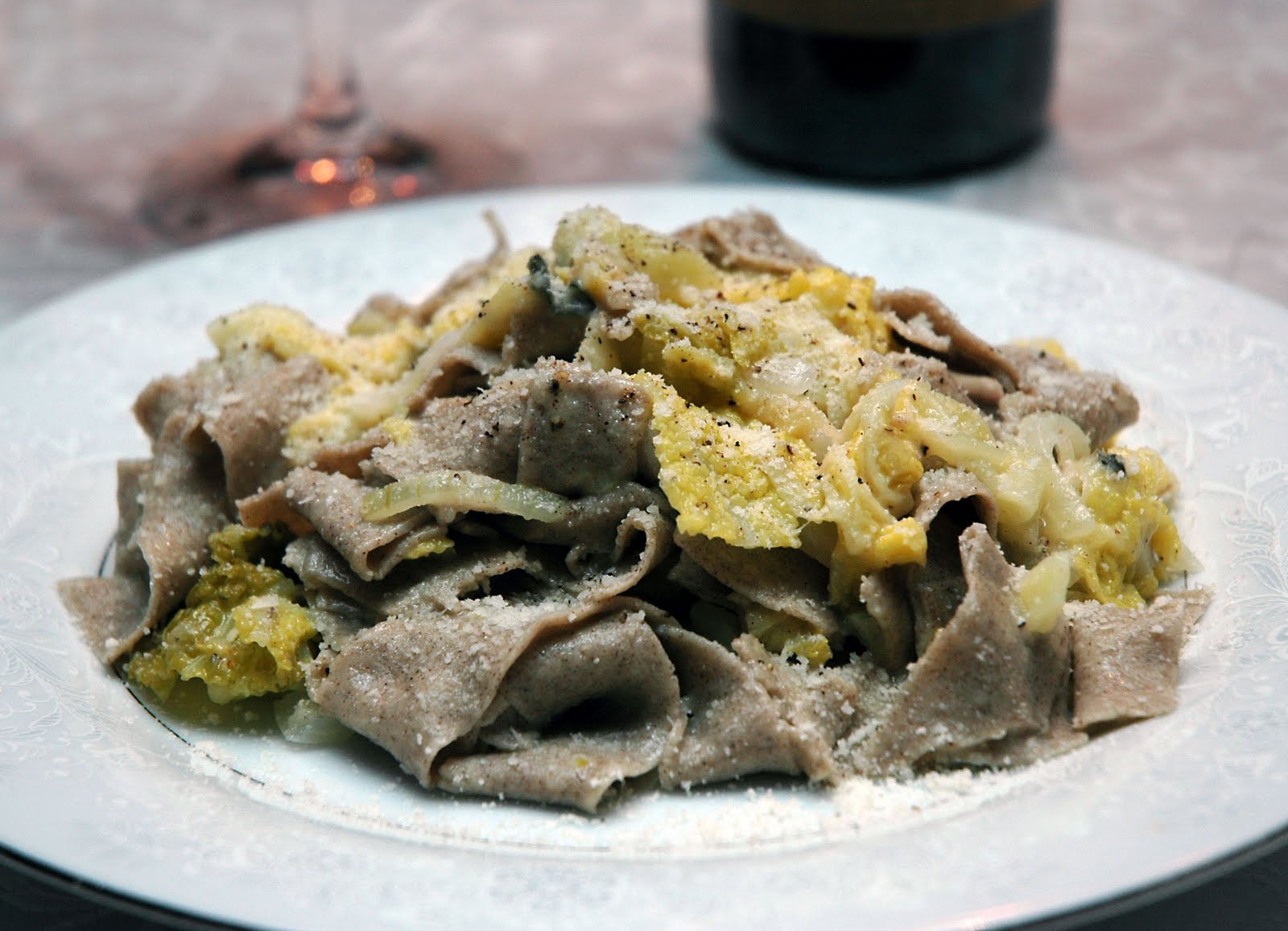
It was enjoyed with a plate of Pizzoccheri Valtellinesi, which is a recipe I’ve been trying to master for a few weeks now. It’s seriously stick-to-your-ribs, home-style, Northern Italian cooking with fresh buckwheat pasta, cabbage, potatoes and onions, in a Fontina and sage butter sauce. Sounds easy right? Well, I’ve been having trouble getting right until—today. It was awesome and the Paolo Bea made it really shine.

2003 Paolo Bea Montefalco Rosso Riserva Vigna Pipparello - The nose showed intense black cherry, cinnamon stick, and chalky minerals with notes of mushroom and forest floor. On the palate, sweet ripe cherry enveloped the senses, like a sweet and savory sauce with beefy notes and clove spice, adding complexities. With each sip, I was tempted to take another. It was soft as silk yet weightless on the palate with high-toned red fruit, hints of mint and herbal tea on the finish. (94 points) Find it on Wine-Searcher!

As much as I love Wine-searcher, sometimes an individual retailer deserves the spotlight: Vinopolis Wine Shop in Portland Oregon has a great selection of Paolo Bea wines. They also carry an excellent selection of wines from around the world, along with some of the most highly sought after Italian wines you could hope to find. If you're interested in exploring the the wines of Paolo Bea, this is a great place to start.

Thursday, August 18, 2011

Antinori: Generations in the making

If you’re a lover of Italian wine, then you must know the name Antinori. With bottles like Guado al Tasso, Solaia and Tignanello; Antinori conquered the fine wine racket with a host of “Super Tuscans” that helped define a generation of winemaking. However, you don’t need to spend upwards of $70 to enjoy a gorgeous bottle of Tuscan juice from this winery, which is now on it’s 26th generation of ownership (that’s right, 26 generations). Antinori also produces a number of bottles in the value category that drink beautifully. One of my favorites value wines is the Antinori Chianti Classico Peppoli. Each year I look forward to the newest vintage for easy drinking and highly enjoyable Chianti.

2008 Antinori Chianti Classico Pèppoli - The nose showed dusty potpourri with fresh crushed cranberry, cinnamon stick, and dark bakers chocolate. On the palate, it was medium bodied with a high level of acidity pushing dry yet intense red fruit and mocha. The finish was long on the palate with some drying tannin and lots of dry red fruit extract. (88 points) Find it on: Wine-Searcher!

I was a little on the fence with this wine but it opened up nicely after a couple of hours open in bottle. Once it started to show a little body on the palate, the dry red fruits and high acidity became more and more tolerable. In the end this is not Chianti for the neophyte, but does provide an interesting contrast to many of the, soft and modern, Chianti on the market these days.

I enjoyed this wine. I won’t put more in my cellar but I would be happy to accept a glass if offered. For a great value white wine from Antinori, I highly recommend the Antinori, Guado al Tasso Vermentino. It's an Italian white that smells and tastes as if it had been plucked right from a Mediterranean coast only days before you tasted it.

Monday, February 14, 2011

“The Italian Wine Masters,” Part 2 Chianti Classico

The Italian Wine Masters is a combined effort between The Consorzi Brunello di Montalcino, Chianti Classico, Vino Nobile di Montepulciano and Conegliano Valdobbiadene Prosecco Superiore. It’s a trade show of sorts, where industry professionals and press are invited to meet the owners and representatives of over 100 wineries from Tuscany and the Veneto, Valdobbiadene wine growing region.

San Felice &  Lilliano Chianti Classico
When I arrived at The Italian Wine Masters, one of the first things on my mind was to develop a strategy. What to taste first, how much time to dedicate to each room, and how to pick producers to visit were the most important things to settle on if I was going to have a successful day. I was surprised to see that my first pick, to visit the Chianti Classico room first, was not a popular choice.

Most attendees flocked to Brunello di Montalcino or to the Prosecco room. However, I’m of the opinion that of all the wines that were represented, Chianti Classico offers the most enjoyment for the best value. Not only that; when I’m coming home from a hard day of work, I don’t feel like decanting a Brunello for a few hours or popping some bubbly; I simply feel like opening a bottle of Chianti Classico. If you don’t agree, then maybe you owe it to yourself to explore these wines a little deeper. Chianti Classico has come a long way in the last two decades.

There were always quality producers turning out remarkable bottles, but to find those producers in the overpopulated sea of mediocre Chianti was near impossible. However, things have changed, and Chianti Classico has made a serious comeback. It’s been a long time since Chianti was just a pizza parlor wine.
Some would say that the best bottles could even stand toe to toe with Brunello. Another development is how many producers are using more traditional blends (Sangiovese with Canaiolo or Colorino). In addition, many producers have begun to use 100% Sangiovese in their Chianti Classico. The end result, whether it’s a showy bottle or an unassuming dinner wine, is that Chianti Classico is truly defining itself as “the wine” of Tuscany.

Before delving into the notes, I would like to mention one other thing that I consider important when selecting these wines for your cellar.
The Chianti listed on these pages is truly Chianti Classico. “Classico” is referring to a specific appellation between Florence and Siena. If you find a bottle of “Chianti”, but not “Chianti Classico.” it will simply not be the same thing. “Chianti” was created for wines made around the “Chianti Classico” region, where they were made in the style of Chianti. Without getting into too many politics, I will say from experience that you will find a more reliable bottle of wine when choosing “Chianti Classico.”

The run-down (by score):
2004 Castello di Ama Chianti Classico (92 points)
2007 Fontodi Chianti Classico Riserva Vigna del Sorbo (92 points)
2007 Bibbiano Chianti Classico Riserva Vigna del Capannino (91 points)
2007 Castello di Ama Chianti Classico (91 points)
2006 Ruffino Chianti Classico Riserva Ducale Oro (91 points)
2007 Agricola San Felice Chianti Classico Riserva “Il Grigio” (91 points)
2006 Agricola San Felice Chianti Classico Riserva Poggio Rosso (91 points)
2006 Carpineto Chianti Classico Riserva (90 points)
2008 Bibbiano Chianti Classico Montornello (89 points)
2007 Capannelle Chianti Classico Riserva (89 points)
2006 Castello di Ama Chianti Classico (89 points)
2007 Fontodi Chianti Classico (89 points)
2008 Ruffino Chianti Classico Tenuta Santedame (89 points)
2008 Tenuta Lilliano Chianti Classico (89 points)
2007 Tenuta Lilliano Chianti Classico Riserva (89 points)
2008 Bibbiano Chianti Classico (88 points)
2009 Carpineto Chianti Classico (88 points)
2007 Ruffino Chianti Classico Riserva Ducale Tradizionale (88 points)
2008 Agricola San Felice Chianti Classico (88 points)

On to the notes:

2008 Bibbiano Chianti Classico – The nose showed wild berry and cranberry. On the palate, I found red fruit against refreshing acidity on a lean yet juicy frame that finished fresh. This would make a great house red for a relaxing weeknight. (88 points)

2008 Bibbiano Chianti Classico Montornello – The Montornello was more refined than the normale with cherry and licorice on the nose. The palate was slightly restrained by this wine’s fine structure but should open up in decanter. A gorgeous expression of spiced red fruit lingered on the finish. (89 points)

2007 Bibbiano Chianti Classico Riserva Vigna del Capannino – The nose showed cherry and dark woods with hints of cinnamon. On the palate, this wine showed a full, structured body with sweet red fruits and a fine, lingering finish. (91 points)

2007 Capannelle Chianti Classico Riserva – The nose showed ripe strawberry, leather and earthy undergrowth. The palate wasn’t as full as you’d expect from the nose, yet it’s balanced and showed dark red fruits and minerals into its medium-long finish. (89 points)

2009 Carpineto Chianti Classico – The nose showed raspberry, dark wood, undergrowth and a hint of manure in a rustic expression of Chianti. On the palate, I found vibrant red fruit that stayed through the finish. (88 points)

2006 Carpineto Chianti Classico Riserva – The 2006 Chianti Classico Riserva kept the same rustic feel on the nose as the normale but with more delineated fruit. On the palate, I found dark red fruits and cedar, leading into an enjoyably fresh finish. (90 points)

2004 Castello di Ama Chianti Classico – The 2004 Castello di Ama Chianti Classico, was easily one of the highlights of the tasting. The nose showed forest notes with earth, undergrowth, mint and cherries. On the palate, I found a beautiful balance of concentration and acidity as lush red fruit and wood was kept in check by the wine’s fine structure. (92 points)

2006 Castello di Ama Chianti Classico – The nose showed dark red fruits, savory beef notes and animal musk. On the palate, I found red fruit against a balanced frame but little else before the wine’s tannin numbed my palate. With age, this wine may blossom but on this day it was dwarfed by the structured 2004 and the rich 2007. (89 points)

2007 Castello di Ama Chianti Classico – On the nose, I found vibrant black cherry with spice and woodsy notes. The palate was full and bursting with flavors of mint and rich raspberry. The finish was medium-long with sweet red fruits lingering on the palate. (91 points)

2007 Fontodi Chianti Classico – The 2007 Fontodi Chianti Classico showed woodland aromatics with undergrowth and hint of evergreen ushering in its red fruits. On the palate, it showed its grace through light, yet well-focused red fruit with hints of tobacco and a bit of drying tannin going into the medium finish. Ultimately, this wine may need to be accompanied by food to reach its apogee. (89 points)

2007 Fontodi Chianti Classico Riserva Vigna del Sorbo – To drink this, and then have the 1999 later in the day, was an interesting peak into what was truly buried beneath the youthful structure of this wine. The 2007 showed red fruits with spice and vanilla on the nose. The palate was structured, showing mulling spice with leather and sour red berries. I believe it’s enjoyable now with a good decant, but it will be truly amazing if left to age in your cellar. (92 points)

2008 Ruffino Chianti Classico Tenuta Santedame – This wine showed perfumed, sour red berries on the nose, followed by forest notes. The palate was light yet juicy with red fruits, but a little dry into the finish. I was impressed by this unassuming Chianti and wouldn’t mind it with a plate of pasta and red sauce. (89 points)

2007 Ruffino Chianti Classico Riserva Ducale Tradizionale – The nose showed red fruits, clay and earth with hints of manure. It was a bit gruff on the palate and drying, which I’ve come to expect from this bottling. The finish was long with spiced red fruits. (88 points)

2006 Ruffino Chianti Classico Riserva Ducale Oro – On the nose, I found dark red fruits with hints of chalk dust. On the palate, it showed an ethereal elegance that I found lacking in the 2004. Hopefully this may be a sign of the producer moving away from the dark brooding character that this wine seemed to epitomize over the last few vintages. The palate showed vibrant black cherry with tobacco, minerals. The finish was long yet slightly tannic. This bottle may find its way into my cellar. (91 points)

2008 Agricola San Felice Chianti Classico – The nose showed crushed red berries, soil and green stems. On the palate, I found sweet, round fruit with a nice balance of acidity. (88 points)

2007 Agricola San Felice Chianti Classico Riserva “Il Grigio” – The nose showed animal musk and dusty black cherry. On the palate, I found vibrant strawberry fruit, spice and earthy minerals. This wine is well structured and has great balance. It was a pleasure to drink. (91 points)

2006 Agricola San Felice Chianti Classico Riserva Poggio Rosso – The nose showed candied cranberry fruit with spice and mint. On the palate, I found red and black fruits with hints of wood on a velvety full body. The finish is long and staying but a bit sweeter than I usually prefer. However, there’s no denying the quality in the glass. (91 points)

2008 Tenuta Lilliano Chianti Classico – The nose showed cherry and earth with notes of forest floor. On the palate, I found round red fruits with hints of violet candies. The finish was long and showed cinnamon and spice. (89 points)

2007 Tenuta Lilliano Chianti Classico Riserva – The nose showed red fruit and pecorino. On the palate, I found silky raspberry fruit and licorice. The finish was pleasant and juicy. (89 points)